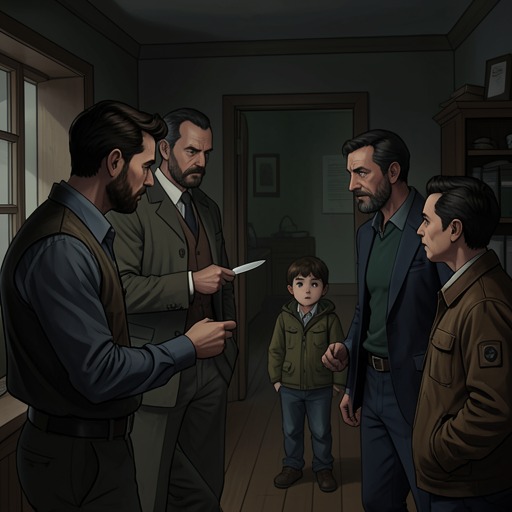
Joe Lewiston humiliates Yasmin Novak
Hold TightJoe Lewiston humiliates Yasmin Novak by making fun of her when she is eleven, an episode whose consequences outlast the visible feature at its center. The mockery leaves Yasmin socially isolated and school feeling unbearable; later, her anger surfaces in a violent fantasy she shares with Jill Baye. The harm also reaches beyond the two girls: Guy Novak confronts Dolly Lewiston, and their exchange turns Yasmin’s humiliation into a conflict between families over accountability, protection, and retaliation.
Background and the Lasting Harm
The insult is presented through its aftermath rather than a full account of the original encounter. Jill remembers the small mustache on Yasmin’s face as the feature that caused all the trouble. Yasmin’s mother, who lives somewhere in the South, possibly Florida, later takes her to a specialist and arranges electrolysis. The hair is gone, but the treatment does not make school less horrible. That contrast gives the incident its defining consequence: changing Yasmin’s appearance addresses the visible source of attention without undoing the social damage attached to it.
The account does not suggest that the procedure restores Yasmin’s ease or removes the memory of being singled out. Jill can still picture the mustache even after it has disappeared. Her recollection makes the past injury present in an ordinary moment between friends, while the continuing misery at school shows that the effects cannot be reduced to appearance alone. The event’s significance lies partly in this mismatch between a problem that can be treated medically and an environment that remains painful for Yasmin.
Anger and the Confession to Jill
In a private conversation with Jill, Yasmin describes having imagined killing Joe. She considers different settings, including a classroom and Joe’s home, and imagines that other people might witness the act. She then rejects the public version of the fantasy as too closely associated with a type of school violence she does not identify with. The details establish the intensity and persistence of her anger, but Yasmin presents the thoughts as random and harmless and says she will not act on them. The passage therefore distinguishes a violent fantasy from a stated plan to carry it out.
Jill does not dismiss what Yasmin has said. She tells her that Joe will pay, and Yasmin agrees that she knows this. Their exchange makes the friendship an important setting for the event’s consequences: Yasmin can disclose thoughts she otherwise keeps private, and Jill responds by affirming that the humiliation should have repercussions. Yet their agreement does not specify what those repercussions will be. The scene leaves a tension between recognition of harm and the possibility that anger might turn toward further harm.
The surrounding actions sharpen that tension without resolving it. Jill carefully sets down the weapon. When a car arrives and Yasmin’s father calls from inside the house, Yasmin calmly puts the gun away in a drawer, arranges things, closes it, and goes to meet him. The ordinary arrival interrupts a charged private moment. Yasmin’s composure and the concealment of the weapon show that she understands the difference between what she has disclosed to Jill and what she reveals to her father; the scene does not establish that she intends to use it.
The Conflict Reaches the Families
Guy’s later confrontation with Dolly makes explicit how deeply he believes the original humiliation affected his daughter. He asks whether Dolly knows what Joe did, and identifies the injury as Joe making fun of an eleven-year-old. Dolly acknowledges that her husband acted foolishly and is sorry, but Guy insists that the result was to make Yasmin’s life a living hell. Their disagreement is not over whether Joe’s behavior occurred; it is over whether an apology settles the matter and what Guy is entitled to do in response.
Dolly frames Guy’s actions as an attack on her family and warns that they will defend themselves. When Guy suggests she may mean a lawsuit, she makes clear that she is not speaking about court proceedings. She describes her warning as a fact and urges him to focus on caring for Yasmin rather than pursuing Joe. Guy does not retreat from his demand that Joe quit, while Dolly refuses to treat the conflict as something Guy alone can prosecute. The exchange broadens the consequences of the insult: a child’s school experience becomes the basis for an adult confrontation, and both parents cast their position as protection of someone they love.
Significance
The episode links a small, specific act of ridicule to several different scales of consequence. For Yasmin, the mockery remains attached to an appearance that electrolysis can change but cannot make socially irrelevant. For Jill, it helps explain her friend’s anger and gives her a role as confidante. For Guy and Dolly, it becomes a dispute about apology, responsibility, and the limits of defending one’s family. These responses do not offer a simple resolution: Dolly says Joe is sorry, but Guy says the harm persists, and Yasmin’s account reveals anger that an apology has not erased.
The narrative places the insult’s aftermath in domestic settings—a conversation between friends and a confrontation between parents—rather than reproducing the original act as a standalone scene. This structure emphasizes duration: the decisive evidence of humiliation is not only what Joe did, but the continuing damage it leaves behind. At the same time, Yasmin’s insistence that her thoughts are harmless and Jill’s confidence that Joe will pay preserve uncertainty about how that damage will be answered. The event thus functions both as a past injury and as an active source of conflict, connecting Yasmin’s isolation to the wider struggle over how her family will respond.